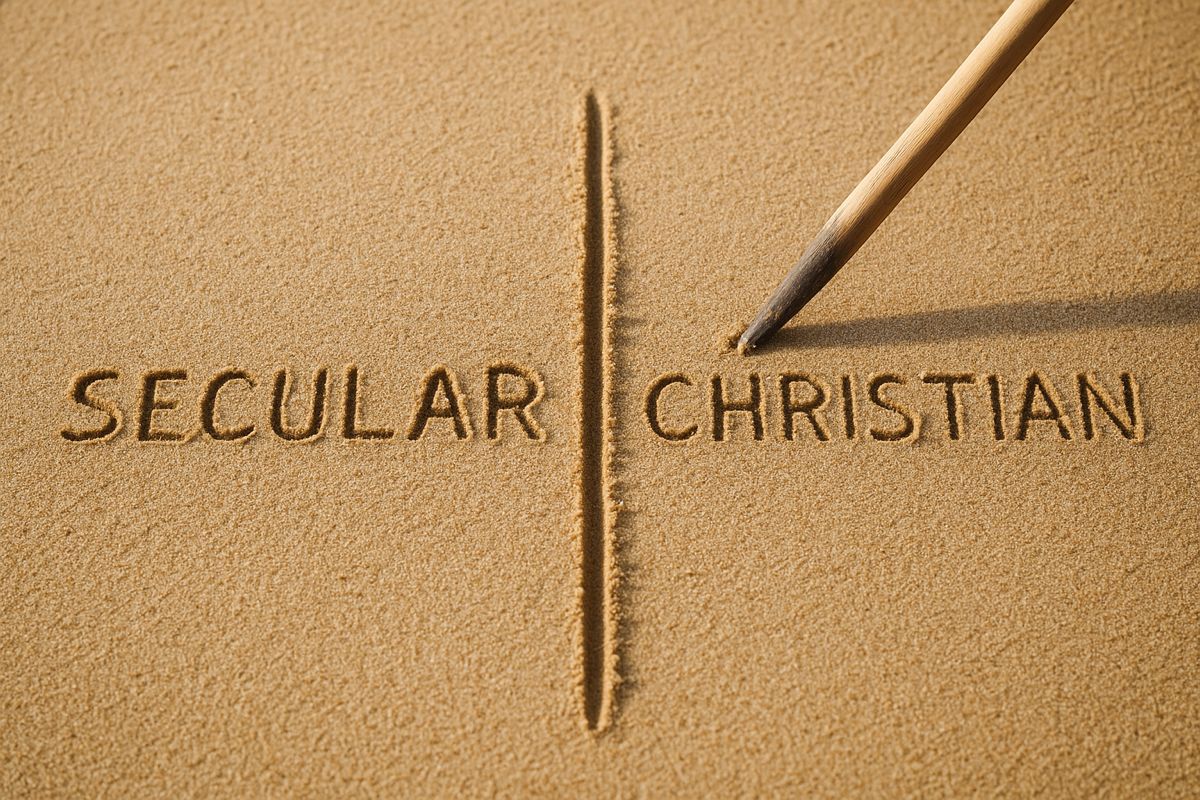
Is it really possible to promote a Christian bioethics today—or to meaningfully engage with secular bioethics from a place of theological conviction? For some, this sounds like a noble yet impossible dream—out of step with pluralistic societies and their ever-expanding moral landscapes. For others, it represents a necessary act of faithfulness in an age where technological power often outpaces moral wisdom.
One way to begin making sense of this question is by leaning on conceptual models. When exploring the complicated relationship between science and religion, for example, Ian Barbour developed a fourfold typology: conflict, independence, dialogue, and integration. While not exhaustive and certainly contested, Barbour’s framework gave many of us a starting point for understanding the possibilities and limits of faith-reason encounters.
In that same spirit, I want to explore how Christian and secular bioethics relate to one another by drawing on a fivefold typology developed by theologian David VanDrunen in his book Bioethics and the Christian Life, specifically in the chapter "Christianity and Health Care in a Fallen World." These models clarify the tensions—and opportunities—in our pursuit of faithful moral reasoning in contemporary healthcare.

But I’m not simply repeating VanDrunen. I want to expand on these categories in light of the real questions Christians face: How should we show up in public? Can we collaborate without compromise? Must we always stand apart?
1. Secular Bioethics Only
This model insists that bioethics should be grounded in philosophical or pragmatic reasoning accessible to all, regardless of religious belief. Religion is viewed as private and inadmissible in public ethical discourse. Tom Beauchamp and James F. Childress, through their principlism framework, argue for a “common morality” shared by all morally serious people and extract four principles—respect for autonomy, nonmaleficence, beneficence, and justice—as the foundation for universal medical ethics. Robert Veatch also operates within this model but takes a different approach, advocating for a social covenant involving all of society in ethical decision-making.
While these models aim for neutrality and inclusivity, they often unintentionally exclude theological voices under the banner of public objectivity. In fact, according to the report Bioethicists Today, 2024, nearly half (47%) of respondents agreed that religious convictions should be considered “irrelevant” or “detrimental” to public bioethics deliberations. While such views aim to preserve neutrality, they effectively marginalize theological voices that approach moral reasoning from a confessional perspective.
2. Christian Bioethics Only
This model roots all moral guidance for health care in Christian theology, especially Scripture. For thinkers like John Frame, there is no legitimate source of moral knowledge apart from God’s revealed Word. Frame applies"sola scriptura" rejecting both general revelation and secular ethical frameworks. Marsha Fowler, representing a more community-and-justice-oriented perspective, similarly places theology at the center of ethical transformation, envisioning the church as a prophetic force actively reshaping healthcare through incarnational ministry.
One could argue that both Fowler and Frame are motivated by deep distrust in the moral reliability of secular structures—Frame from a theological concern for Scriptural authority, Fowler from a desire to root justice and healing in the embodied witness of the church. Though their theological accents differ, both seem to believe that Christian communities must offer something more than critique—they must live out an alternative moral vision. While this model offers deep theological coherence, it tends to isolate Christian moral reasoning from broader moral discourse.
3. Secular and Christian Bioethics Identical
This model seeks to bridge theological and secular perspectives by suggesting that, despite different foundations, both may arrive at the same moral conclusions. VanDrunen associates this model primarily with Roman Catholic ethicists who emphasize natural law as a universally accessible source of moral truth. Writers like Richard McCormick, Lisa Sowle Cahill, James Walter and Thomas Shannon suggest that theology illuminates and deepens, but does not fundamentally change, the moral values shared by all people.
However, it is worth questioning whether these thinkers would actually endorse the idea that secular and Christian ethics are identical. Many natural law theorists would argue that their work is theologically informed but intended to be accessible to those outside the faith. That doesn’t mean the two frameworks are the same—only that they can converge at times. This category, while useful in describing real points of overlap, risks oversimplifying the complex interplay between grace, revelation, and natural reason.
4. Secular and Christian Bioethics Radically Different
This model emphasizes the deep incompatibility between Christian and secular bioethics in a pluralistic society. H. Tristram Engelhardt Jr., especially in his later Eastern Orthodox writings, is the clearest exponent. He argues that secular society lacks the metaphysical and theological consensus necessary for meaningful moral discourse. As a result, secular bioethics is reduced to procedural agreements among"moral strangers", guided only by the “principle of permission.” In contrast, Christian bioethics, grounded in a shared vision of life and union with God, is rich, coherent, and binding within believing communities.
Engelhardt goes so far as to call for a separate Christian healthcare system, one capable of embodying these distinct values. This model powerfully critiques the fragmentation of modern ethics but can foster isolation if it resists all public engagement.
5. Distinct but Legitimate
VanDrunen’s preferred model acknowledges that while Christian and secular bioethics are grounded in fundamentally different starting points, both can offer meaningful moral insights. They are not identical, but neither are they entirely incommensurable. Catholic thinkers like Edmund Pellegrino and David Thomasma demonstrate this with their two-volume exploration of virtue ethics. Their first book draws on philosophical virtue theory to define the internal morality of medicine; the second brings in Christian charity as a supernatural perfection of these natural virtues.
Evangelical writers like John Jefferson Davis, Scott Rae and Paul Cox also adopt this model. They encourage Christians to engage public discourse using arguments from general revelation while still affirming the indispensable moral vision provided by Scripture. Meanwhile, authors like Joel Shuman and Brian Volck call for embodied Christian community care while acknowledging the legitimacy (and limits) of modern medicine. This model allows Christians to engage publicly without diluting their convictions, and to speak theologically without retreating into sectarianism.
How we distinguish between these five models—and whether Christians need to overlap or transition between them in different contexts—are some of the key questions that guide our work here at Bioethics.life. Ultimately, the answer is not found in a fixed category but in robust engagement with the many segments and traditions of the Christian faith. That’s what makes fostering a Christian bioethics not just a theoretical task, but a missional enterprise. That is the aim of the Christian Bioethics Network. Join us for more resources and support.
From Typology to Testimony: Our Mission at the Christian Bioethics Network
In addition to navigating the theological distinctives that exist across Christian traditions, a truly Christian bioethics must also grapple with the political and social forces shaping health care in different regions of the world—particularly in Latin America. While there is significant and growing interest in bioethical reflection across the Global South, the assumptions, challenges, and frameworks often differ from those in Western contexts. Any serious attempt at Christian bioethics must therefore be global in perspective, responsive to local realities, and open to the diverse ways Christian communities interpret and embody moral witness.
In Bioethics.life we believe that Christian bioethics is not a retreat from the world, but a faithful witness within it. These models are not just academic frameworks—they reflect deeper assumptions about God, humanity, and our moral calling. Each one challenges us to ask: Will our ethics be shaped by fear, pride, or faithful presence?
That’s why our Christian Bioethics Network is built on six core tenets:
- Rooted in Scripture
- Faith and Science in Dialogue
- Life at Every Stage
- Advocating for the Vulnerable
- Equipping the Church
- Public Witness
We hope this framework helps you name where you are—and where God might be calling you next. If you’re a pastor, educator, healthcare worker, or simply a Christian longing for deeper ethical clarity, we invite you to explore our growing resource library and consider joining the Christian Bioethics Network.
Because in the messiness of medical ethics, our calling is clear: to speak the truth in love, to act justly, and to walk humbly with our God.

